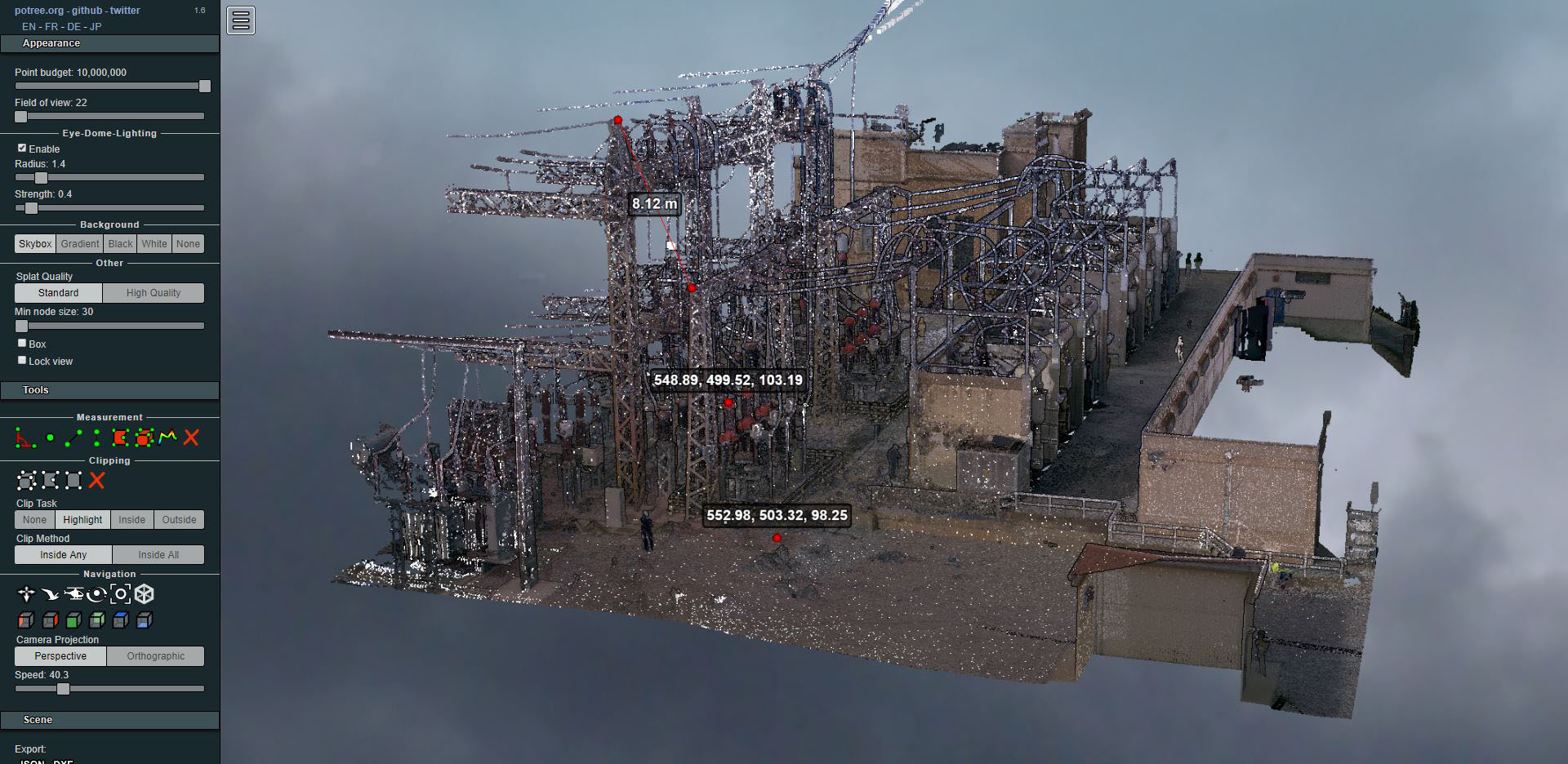
Laser scanning of an electrical substation
- Uncategorized


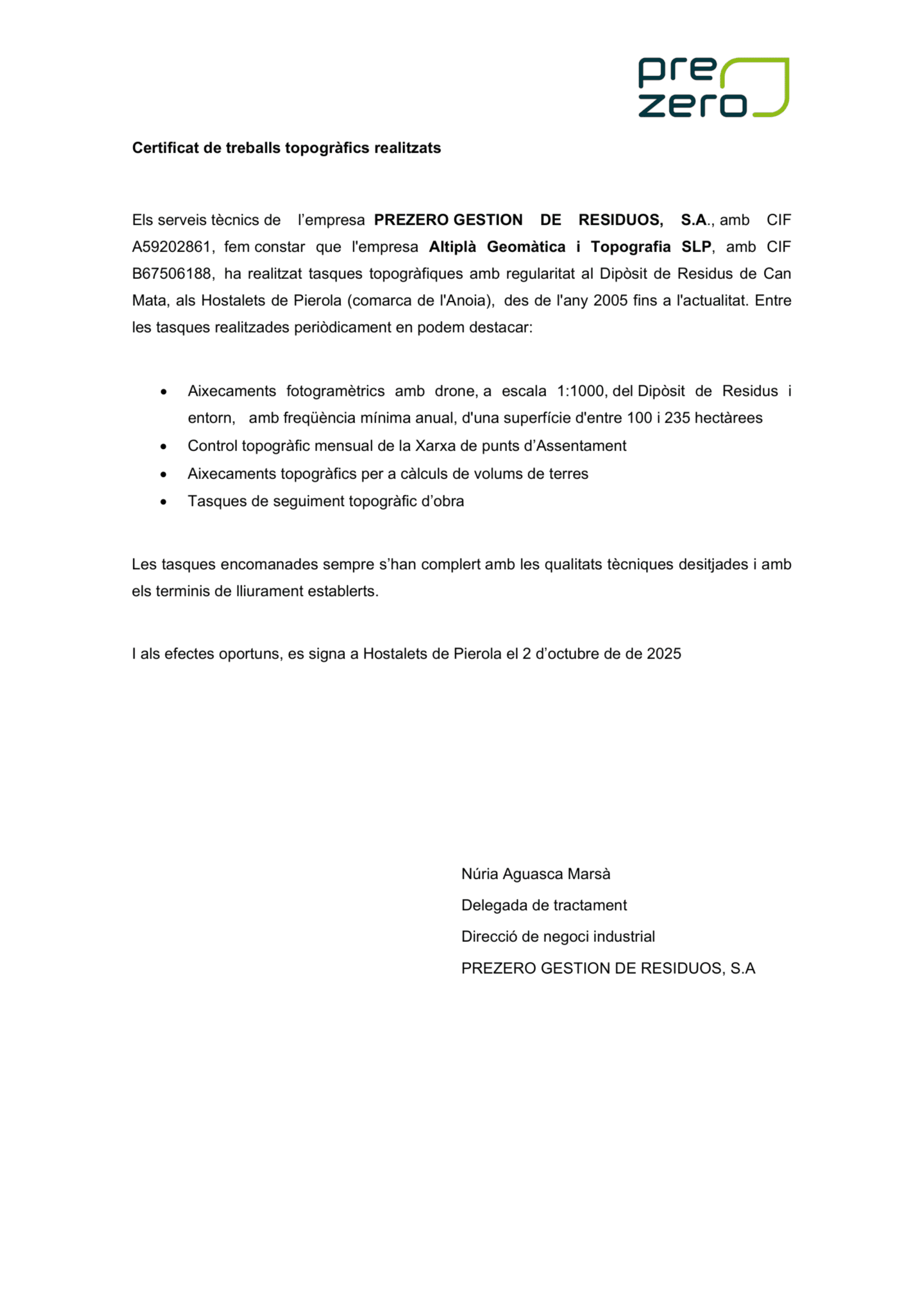
At the landfill, work is carried out primarily using bi-frequency GPS with a fixed base and calibration against a local reference system, thereby achieving the precisions required for control—mainly in elevation—of the entire operation.
Depending on the size and waste intake of each managed landfill, our visits are more or less spaced out, with the Catalan Waste Agency also setting the schedule, as it audits them regularly.
They are carried out Topographic for waste volume calculation as well as for the preparation of an iso-pacs plan that will be used to monitor compliance with the closure quota and to locate and measure the various points where exploitation can continue. These topographical surveys are also used in some cases to redesign the routes of vehicles that bring in waste.
The settlement points They are measured periodically and we have two types: fixed, located in the closed areas, and virtual, located in the exploitation areas. Monitoring these points is key to landfill management, as it provides essential information on the settlement trend of the residue and thus allows for more precise control and planning of the total cell capacity. Monthly fluctuations vary, but at a minimum a settlement point drops by 0.01 m per month.
The circumference of the also measures Leachate wells for the control of the collection network for this liquid waste resulting from the decomposition of garbage.
The measure of inclinometers, Mainly located on the outer perimeter of the landfill, it will serve to detect any impact on the surrounding terrain that the large volume of waste and earth movement may generate.
All, or almost all, controlled waste disposal sites work to reduce the impact of these operations, which always fall short of the huge demand for space to dump the trash we humans generate.
Altiplà works and has worked at the main controlled reservoirs in Catalonia: Can Mata, Coll Cardús, Reus, Palautordera, Orís, Bages, Pujalt, etc.
Thus, over the years, we have seen management improve, building new sorting plants where selected waste is more accurately separated, or harnessing the biogas emitted by the leachate, which is increasingly used as fuel for the vehicles that operate at the landfills. In this bio-gas extraction process, the water is purified and inert residues are obtained that will be processed in another deposit.
We have also seen how some closures succeeded in restoring vegetation and ecosystems, or how the use of birds of prey—rather than more environmentally aggressive methods—is employed almost continuously to scare off the immense flocks of gulls that circle the waste.